
Discovery on the Discoverers: Why Product Management Needs a Reboot
AI velocity, async alignment and higher user expectations broke the PM toolkit. Here’s a one‑week playbook to fix it. With why-gating.
Pancrazio Auteri

In building our product, I often defaulted to experience and anecdotes, until my co‑founder kept asking the most useful question: “Why that?” It nudged us back into true discovery: stop guessing, start mapping. And why-gating.
For years we did discovery for our employers and their users: interviewing, journey‑mapping, obsessing over pain points, current solutions and desired outcomes. Now we’re building Product Weaver for product managers and startup founders like us. But we rarely turn that lens on ourselves, the product people.
Let’s treat the “Product Manager” as the user persona and the “Modern Tech Company” as their environment. The signal is clear: PMs are frustrated, burnout is rising and current tools and workflows aren’t addressing the core struggles.
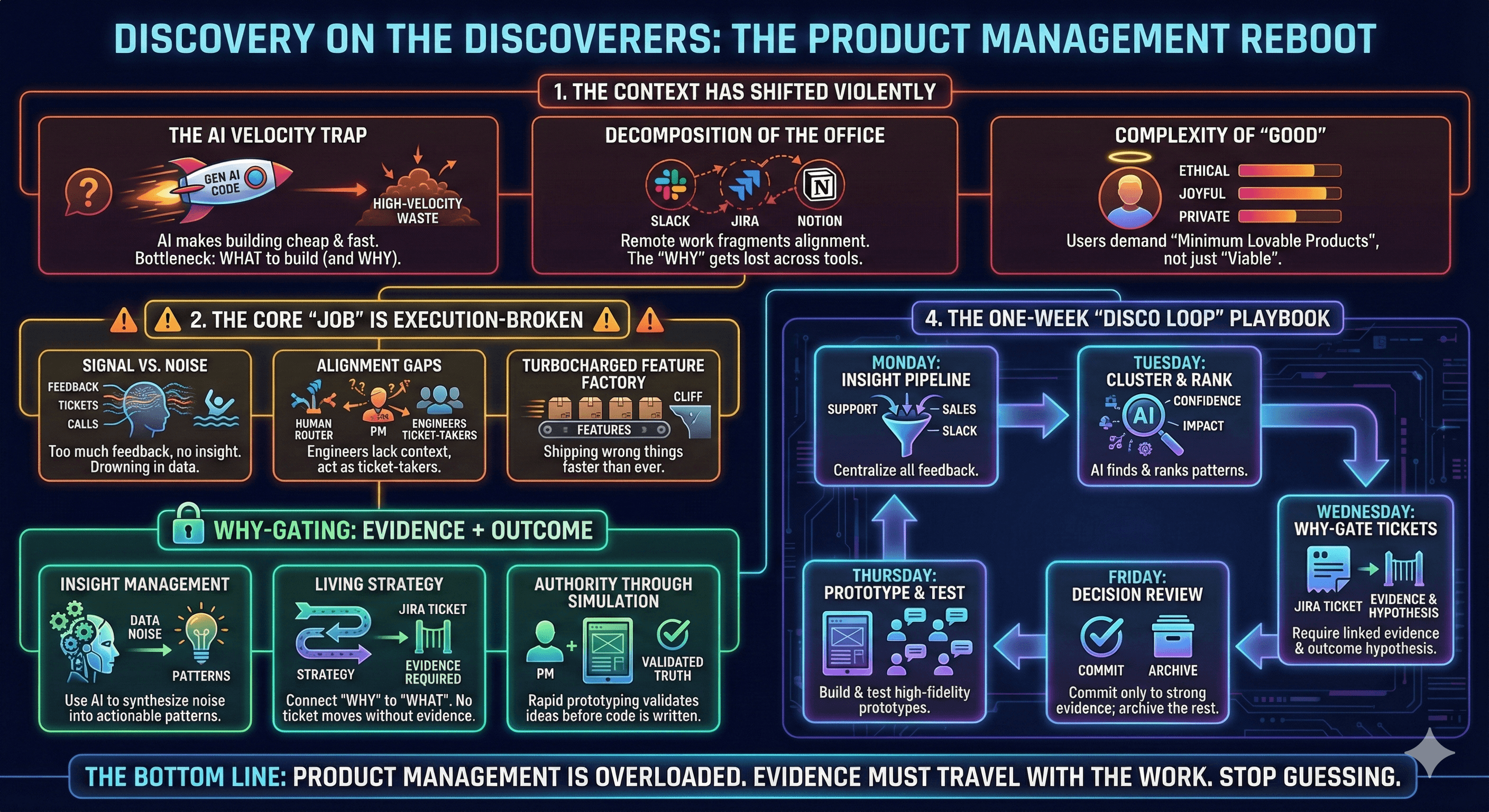
It's a 10 minute reading. If you're a visual person, this infographic is for you.
Don’t we already have the tools?
The product teams we talked to report stale documents, scattered context and almost nobody reading their roadmap slides, PRDs, tickets, Slack canvases, internal pages or Kanban boards. Even with excellent Notion+Linear setups, onboarding new team members and getting them up to speed still feels like an Escape Room rather than a New Hire Orientation.
Research notes: Based on 153 recent PM/founders interviews and advisory conversations (seed to Series B, primarily SaaS). Patterns were consistent across early‑stage startups and mid‑size product teams.
Why now?
Because the context has changed. Fast.
We’re no longer building in the era of the Agile Manifesto. We’re operating in the age of Generative AI, async‑first organizations and users who expect hyper‑personalization and ethical design.
The Core “Job”
At its highest level, the job of a PM hasn’t changed:
Formulate and deliver a solution that solves a customer problem in a way that is desirable, feasible and viable for the business.
What’s breaking is the execution. There’s a widening gap between the Desired Outcome (shipping high‑value, problem‑solving products) and the Actual Experience (shipping feature‑bloat while managing stakeholder anxiety).
Three New Pressures
Before describing the struggles, let’s see what has changed in the environment.
The AI Velocity Trap
Generative AI is driving the cost of creation toward zero. Developers and agents can ship code faster than PMs can write specs. The bottleneck moved from “How do we build this?” to “What exactly should we build? And why?”The Decomposition of the Office
Remote/hybrid work killed “management by walking around”. Alignment must be written, visualized and asynchronous.The Complexity of “Good”
Users (especially the rising Gen Z) expect joyful, inclusive, privacy‑conscious experiences. MVP shifted from Minimum Viable to Minimum Lovable, increasing the burden on discovery and design.
The Struggle Map: Where Today’s Toolkit Fails
1. Signal vs. Noise Asphyxiation
Old: Getting enough customer feedback.
New: Drowning in unstructured data: Slack, Discord, transcripts, support tickets… A human PM can’t manually synthesize the deluge into insights anymore.
Example: “Onboarding confusion” surfaces 18 times in two weeks across support and Slack, but no insight cluster or experiment links it to a fix in the work plan or release notes.
Result: We ignore data or cherry‑pick to validate biases. Discovery becomes performative.
2. The Alignment Gap in an Async World
Old: Getting stakeholders in a room to agree.
New: Keep a distributed team aligned when the “source of truth” is fragmented across Jira, Notion, Slack, Figma and PostHog.
Pain: The “Why” gets lost in the “How”. Engineers feel like ticket‑takers rather than problem‑solvers. And see (busy) PMs as unresponsive, with shallow answers.
Example: An engineer closes three tickets that match the spec but not the user’s goal because the Why never traveled with the What.
Result: PMs become human routers, copy‑pasting context to prevent strategy evaporation.
3. The Feature Factory, Turbocharged
Old: Outputs over outcomes.
New: AI lets us build the wrong output at lightning speed.
Pain: Organizations celebrate velocity (“Look how much we shipped with Cursor!”). If discovery doesn’t match development speed, we are sprinting faster toward a cliff.
Result: High-velocity waste.
The Opportunity: Tools That Actually Help Product People
1. From “Project Management” to “Insight Management”
We need augmented discovery: ingest the noisy calls, tickets, emails, interviews, and synthesize patterns the human brain misses.
Solution to validate: An “autopilot for empathy” surfacing weekly patterns (“7 users mentioned this struggle this week”), clustering evidence by segment/severity/impact and linking directly to issues.
2. The Living Strategy
Static roadmaps are dead. Keep the Why attached to the What via dynamic, visual alignment that links code and work items to customer goals and evidence.
Solution to validate: Imagine a workflow where a Jira issue can’t change state unless linked to a validated insight like a user quote, metric or experiment, and a measurable outcome. Strategy stays attached; context follows the work.
3. Authority through Simulation
PMs don’t have formal authority; they need evidence.
Solution to validate: Rapid prototyping and simulation that produces high‑fidelity prototypes in minutes, validating desirability before engineering writes production code. Authority comes from demonstrated truth.
One‑Week Playbook: Disco Loop and Why-gating
Goal for the week
Create a lightweight discovery-to-delivery loop where
every ticket is backed by evidence (Why-gated)
prototypes are validated fast
decisions are documented for reuse
Let’s call it Disco Loop. Inspired by the focus of the Design Sprint and designed to be repeatable by a stable team.
Team & tools
Who: PM, Designer, Tech Lead/Engineer, Support/Success/Marketing/Sales rep (as needed)
Tools: your issue tracker (Jira/Linear), knowledge base (Notion/Confluence), feedback sources (Zendesk/Intercom/CRM), analytics (PostHog/Amplitude/Mixpanel), AI assistant, prototyping tool (MagicPath/Figma/Framer), meeting recorder (tl;dv).
Flow at a glance:
Signals → Clusters → Why-gated Tickets → Prototype → Test → Decision → Outcome Review
Monday: Stand up an insight pipeline
Objective: Centralize customer feedback and make it machine‑readable.
Inputs: Past 2–4 weeks of support tickets, sales call notes, Discord/Slack feedback, NPS verbatims, user interviews.
Tasks:
Create a single “Insights Inbox” (Notion database or a shared spreadsheet).
Define structure to tag each insight: Topic, Segment, Severity (Low/Med/High), Frequency count, ARR/Impact estimate, Source, Date.
Connect sources: auto‑forward support tickets and NPS verbatims; paste top 10 recurring Slack/Discord threads; attach call transcripts.
Write a 5‑line taxonomy guide so tagging is consistent.
Output: An insights table with ≥50 tagged items and a living intake process.
Pitfalls to avoid: Tag overload; unclear definitions; mixing ideas (solutions) with evidence (quotes/events).
Tuesday: Cluster and rank signals
Objective: Reduce noise into 3–5 prioritized themes.
Inputs: Insights Inbox + analytics slices (e.g., conversion drop, churn reasons).
Tasks:
Use AI to suggest clusters of insights; review manually; merge duplicates.
For each cluster, add: representative quotes, frequency, severity, segment, cost-of-pain (ARR/time lost).
Score clusters (1–5 points)
Impact on users or business
Confidence in the evidence
Effort to create solutions in that cluster
Compute ICE score = Impact × Confidence ÷ Effort.
Pick the top 3 themes; write one-sentence problem statements per theme.
Output: Ranked themes with evidence packs and ICE scores; a 1‑page problem brief.
Pitfalls: Confusing loud voices with large segments; skipping confidence notes or contradictory evidence. Cherry-picking evidence to confirm your biases.
Wednesday: Create “Why‑gated” tickets
Objective: Ensure work cannot move without a linked insight and outcome hypothesis.
Inputs: Top 3 themes + problem briefs.
Tasks:
Add an Issue Template with required fields:
Problem statement (user-centric)
Linked insight IDs (min 2 sources from the Insights table)
Outcome hypothesis (metric + target + timeframe)
Proposed approach (one paragraph or prototype link)
Risk/unknowns
Configure a simple rule: Issues can’t move from “To Do” to “In Progress” unless “Insight IDs” and “Outcome hypothesis” are filled. This is the essence of why-gating.
Groom 5–8 candidate issues; drop or park those without evidence.
Output: A pruned, evidence-backed backlog; 3–5 “Why‑gated” tickets ready to prototype.
Pitfalls: Template bloat; vague outcomes (“improve onboarding”) instead of specific targets.
Thursday: Prototype and test
Objective: Validate desirability and usability before writing production code.
Inputs: 3–5 Why‑gated tickets.
Tasks:
Build high‑fidelity prototypes (MagicPath/Figma/Framer); keep scope to single flow per ticket.
Run 5 task‑based tests per prototype; capture success rate, time to complete, top quotes, confusion points.
Update each ticket with: prototype link, test summary, clear decision (proceed/iterate/kill).
Output: Evidence-rich prototypes and test summaries; clear go/no‑go signals.
Pitfalls: Overbuilding prototypes; recruiting the wrong users; relying only on opinions without tasks.
Friday: Decision review and ship plan
Objective: Commit to the work backed by the strongest evidence; document decisions.
Inputs: Updated tickets + test summaries + analytics context.
Tasks:
Hold a 45‑minute “Evidence Review” with PM, Designer, Tech Lead.
Move forward only on tickets with clear user value and measurable outcomes; archive or iterate the rest.
Create a 1‑page Brief for each approved ticket:
What (scope)
Why (linked insights)
Evidence (quotes, metrics, test results)
Outcome (metric target)
Owner + timeline
Share briefs in Notion and announce in Slack with links; schedule an outcome check in 2–4 weeks.
Output: A small, focused commitment list with public briefs and owners.
Pitfalls: Slipping into velocity‑worship; vague ownership; not scheduling the outcome review.
Lightweight templates (copy/paste)
Problem statement: “For [segment], when [trigger/context], they struggle to [job], leading to [pain/impact]”.
Outcome hypothesis: “If we [change], for [segment], then [metric] will improve from X to Y within Z weeks”.
Evidence pack: 3–5 quotes + 1 metric + 1 observation/video clip.
Weekly success criteria
≥70% of tickets in progress have ≥2 linked insights and a metric hypothesis.
At least 2 prototypes tested with 5 users each.
One shared “Decision Brief” per shipped commitment.
A scheduled outcome check for each commitment.
Roll‑forward habit
On Monday next week, add new feedback to the Inbox, re‑rank clusters and adjust the backlog. Keep the loop small, fast and evidence‑led.
Conclusion
Product management isn’t broken, it’s overloaded: AI accelerates creation, remote work fractures alignment and users raise the bar.
The antidote isn’t prettier roadmaps; it’s a system where evidence travels with the work plan and truth is validated before code.
Start small. Run the one‑week playbook: centralize signals, cluster themes, gate work by Why. Then prototype, test, decide. In a world sprinting toward output, your edge is disciplined discovery that turns noise into decisions and decisions into outcomes. Find your way of why-gating.
Make it concrete: pick one theme this week, ship one evidence‑backed change, measure the result and share a brief (What, Why, Evidence, Outcome) with your team.
Write your hardest struggle (and one practice that works) and send me a message.
If this resonated, share this with a PM who needs a reboot.
Wishing you a bright Winter Solstice and a joyful start to 2026. See you in the new year!
Pan Out